


Free hosting seems quite attractive for those who are just planning to create a website or who have a limited budget at the start of the project. It is mostly provided with website builders such as Wix or Shopify.
However, free hosting has some pitfalls that you won’t read about in the promo on the builder or hosting provider’s website, but which you are likely to encounter during use.
In this article, we will look at 15 reasons why you shouldn’t use free hosting. We will also discuss the limitations it imposes and how they can affect your website.
Free web hosting limitations
1. Limited resources and capabilities
Free plans impose much stricter limitations on resources such as disk space, bandwidth, and computing power. This can lead to slow website performance or even unavailability during traffic spikes.
Another way hosting companies limit resources is by blocking certain types of files that take up a lot of system resources, such as videos.
And since you are not paying for the service, you have no leverage to get better service.
Paid hosting usually comes with the following features:
- control via a control panel (cPanel, DirectAdmin);
- one-click installation of popular scripts;
- email configuration;
- database management;
- adding and configuring subdomains;
- automatic backups, and much more.
These features are not offered by free providers. You get essentially “barebones” hosting, which can be difficult to use at first.
2. Low reliability
Free hosting does not guarantee stable website performance. Due to server overload, you are much more likely to experience prolonged downtime – moments when your website is unavailable to visitors – than with paid services.
Not all free hosting providers can provide adequate quality processors and disks, so their servers are often shut down for maintenance due to malfunctions or simply negligence.
3. No or limited technical support
Usually, free hosting providers either do not offer technical support at all, or you cannot reach them by email or phone. This disadvantage becomes particularly acute when you lack technical expertise in certain installations or settings and need advice. Or when something has gone wrong, the website is down, and you need to restore it quickly. Of course, this can happen at any time of the day.
So, YES, round-the-clock expert support from a host is not so much an advantage as a necessity.
4. Security issues
It is unprofitable for a free host to develop its own or install expensive security software. Accordingly, your website may be more vulnerable to DDoS attacks, viruses, and vulnerabilities of the shared server. This happens because you don’t receive backups, an SSL certificate (even free options are not always available), and other security features aren’t provided.
In addition, all confidential information used on your website may be sold to third-party companies without your knowledge.
5. Slow website loading speed
Because free hosting providers usually place too many accounts on a single server, the loading speed of your website pages can reach 3, 4, or even more seconds. And if you add to the server load its geographical distance from your target audience and the lack of caching and optimization of the site itself, the loading speed can be catastrophically low.
Since this is one of Google’s ranking signals, with free hosting you may get slower file read/write speeds (up to 500 MB/s), longer server response times (> 1800 ms), and, accordingly, lower positions in search results.
Here’s a quick tip on how to check the server response time. Go to “Developer Tools” ⇒ “Network” ⇒ “Doc” ⇒ ‘Waterfall’ ⇒ “Waiting for server response”.
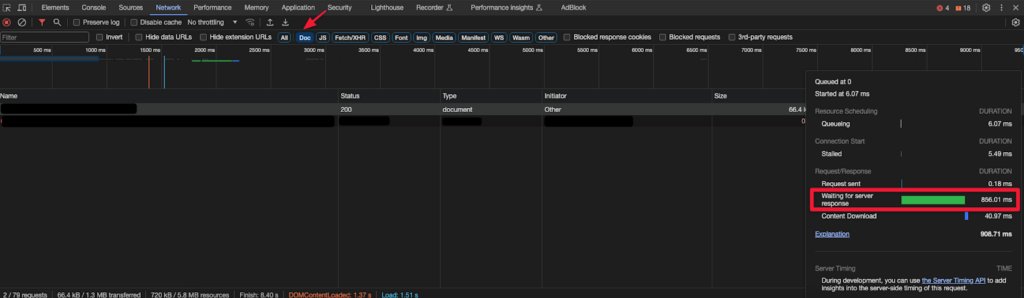
You can read about how to reduce server response time here.
6. Free advertising on your website
In order for your website to be profitable for the “free hosting” provider, advertisements that are often unprofessional and intrusive may be placed on your website without your consent.
You will not receive any profit from these ads because, as a rule, they are of low quality and are not related to the subject matter of your resource.
Not always, but sometimes on free hosting services, visitors first see ads when loading your website, and the content itself is displayed only after scrolling the page. You can imagine what impression such a website can make on visitors. Chaotic advertisement on a different theme will also have an impact on Google that your website is not as user-focused and authoritative as your competitors’ site with regulated advertising.
At the same time, you will most likely not be able to place your own ads on the site.
7. No backup from the host
Backup is a copy of your website which contains all information including configurations, databases, file, all website UX, etc. and can guarantee your website quick restoration. You may think that nothing will happen with the site but it is incorrect. Server crashes, unsuccessful plugin installation or accidental file deletion may occur unexpectedly.
Some free hosting services do not back up data, so if you do not periodically back up the site yourself, there is a possibility of losing all your work in the event of a failed update or an error by the site administrator or developer.
8. Restrictions on domain selection
Free plans usually limit the ability to use your own domain name. Instead, you will get an address based on the provider’s domain, which will result in something long like yoursite.freehosting.com.
Such a domain is difficult to remember, so it can negatively affect your branding and people can even be confused when seeing two different brand names, also it can be associated with spammy and low-quality sites.
9. Unpredictable costs
Even if the hosting itself is free, you often have to pay for additional services. To gain an optimally working website except of hosting you should also have:
- SSL certificate
- Control panel (not necessary but makes work easier)
- Using a custom domain
- Email accounts
- Backups
In order to provide a normal site to your visitors these factors are essential.
10. It is difficult or impossible to transfer a website to another provider
Free hosting services usually have restrictions on server access. Therefore, when attempting to transfer a website, you simply will not be able to connect via FTP to retrieve all the necessary files from the server.
So people who have invested months or even years in a project are forced to pay extra for a developer to manually transfer all the website content to the servers of a full-fledged hosting company.
And if it is a hosting constructor, as is often the case, there is no guarantee that even with the necessary files, the site will work on other servers.
11. You can lose access to your site forever
If a free hosting provider suddenly goes out of business, there is a non-zero chance that you will not be able to get your site and domain back. Such hosting providers usually do not provide any guarantees for data preservation in case of unforeseen circumstances. Sometimes this is even stated in the public agreement.
12. No option to set up redirects
Redirects are an important part of every site when you need to fix broken links or manage temporary marketing campaigns. Without them 404 errors will take over your website, frustrating visitors and hurting your SEO.
If you ever need to redirect visitors from one page to another, you will hardly be able to do so with free hosting. And this is actually a bad solution, because redirects are quite common on live websites.
13. WordPress cannot be installed
WordPress is the world’s most popular CMS (content management system). Millions of successful websites have been created using this engine. Not to mention the huge community and thousands of guides on building websites on WP. However, most free services do not allow you to install WordPress because it requires more resources than they can provide.
There may also be a situation where WordPress can be installed, but the servers are simply unable to run it.
For WordPress sites, it is better to use specialized WordPress hosting with the ability to install CMS with one click in the control panel and all the necessary optimizations, including the LiteSpeed Cache caching and site acceleration plugin.
14. No PHP or MySQL support
These technologies are often used when creating websites, especially in e-commerce. PHP and MySQL are necessary if you plan to deploy a website on a CMS: WordPress, Joomla, Drupal, or any other. On paid hosting, PHP can be configured simply in the hosting control panel.
In contrast to paid hosting, free hosting services usually do not support PHP and MySQL. Therefore, you simply will not be able to host such a website on free hosting and connect all the necessary extensions for it to work properly.
15. SEO issues
Anything that is free can fail unexpectedly. This is what happened with Wix when websites created on the builder could not be indexed. The same thing happened with Let’s Encrypt when the root certificate expired and millions of websites around the world were at risk of receiving a “Connection is not secure” warning. The most frequent issues that can affect your website correct work are:
- Poor loading speed due to overcrowding of a physical server. When you buy a product from a reliable hosting provider even with shared hosting, your physical server will not be overloaded by a huge number of customers, unlike free hosting, which keeps its server always overloaded.
- The same reason also affects your uptime. High-quality hosting providers usually guarantee decent SLA from 99.90% to 99.99%, which is not something you can expect from free hosting.
- The third reason to avoid free hosting is the risk of cyber attacks. Free hosting places your website on a shared IP. If another site on the same IP sends spam or engages in harmful activity, Google may flag your site as potentially unsafe. This can result in your Gmail being blocked and severely damage your reputation. Even if users don’t notice, Google may drastically lower your website’s ranking.
- I’m sure you have seen these distracting advertising banners that are placed on many websites, but surprisingly not on all of them. It is unfortunate to report, but in most cases, these banners are placed by a free hosting provider to earn money, and they can’t be removed without the provider’s permission. Chaotic advertisement on a different theme will signal Google that your website is not as user-focused and authoritative as your competitors’ websites with regulated advertising.
- The next “surprise” that will wait for you around the corner is that you will be able to install a very limited number of things on your website. For example, a limited number of domains to choose from, problems with SSL certificate installation, as a small number of providers sell free SSL certificates, issues with caching configurations, database optimizations, etc., that affect your website’s loading speed.
In fact, all the shortcomings of free hosting – slow loading speeds, downtime, indexing issues, spamming advertisements, hacking attacks – will push your website lower and lower in search results.
What to choose instead of free web hosting?
As we have already explained why choosing free of charge web hosting can be dangerous for your site, a reasonable question arises: “What should you replace it with?” We have several options available for you.
It may seem obvious that if a free option is unreliable, the only alternative is a paid one. It is essential to note that there are two primary types of paid hosting: managed and unmanaged.
Unmanaged web hosting offers you a part of the physical server, which should manage yourself. When buying an ordinary unmanaged web hosting, you may remember that your provider should be responsible for maintaining data center infrastructure, web server software, and support internet connectivity. Everything else you should do on your own or buy an additional service like automatic backups, website migration, or managed updates.
Managed web hosting offers you a part of the physical server where everything should be managed by your provider. The tasks that need to be managed include backups, updates, website security, email accounts, DNS settings, CMS configuration (if applicable), as well as installing themes and plugins.
To see the difference between free, managed, and unmanaged web hosting, we can compare them by basic features.
| Characteristic | Free Hosting | Paid Unmanaged Hosting | Paid Managed Hosting |
| Cost | $0 | Usually start from $0,50 to $20+ | Usually start from $0,50 to $20+ |
| Management | You are responsible for everything | You manage almost everything by yourself; what the provider is responsible for varies. | All management work is made by a provider |
| Domain name | yoursitename.hostname.com | yoursitename.com (or any domain you want). In most cases, you will manage everything by yourself. | yoursitename.com (or any domain you want). Everything transfers and configurates by a provider |
| Ads on site | Provider can post any advertisement on your website without your permission | You control all content that appears on the website. | You control all content appears on the website |
| Performance | Slow | Can be fast and stable if you will care about the server all the time. | Fast and stable, because of a provider constant monitoring |
| Security | Extremely low. Some of the hosting companies can provide free “Let’s encrypt” SSL certificates but, usually, is an exception. | Security can be on a high level if you manage everything properly and choose a hosting provider that doesn’t overload its servers | Strong. Include SSL certificate (free or paid, is optional), malware protection, DDoS attacks protection, real-time monitoring and so on |
| Support | No support | In most cases, providers offer free 24/7 support, but the number of settings they make is really limited. | 24/7 for most of providers |
| Uptime | Low with no guarantees | Usually have some guarantees but downtime can continue longer. | 99.9% – 99.99% |
| Storage | Limited | Much bigger than a free plan, scalable. | Much bigger than free plan, scalable |
| Traffic limit | Low | High | High |
| Scalability | Unavailable. The only way to scale is to buy a paid plan and it will take from a few hours to a few days. | Can easily switch to another plan but needs to configure almost everything by yourself. | Can be upgraded easily, everything managed by a provider. |
In conclusion
Looking at the bigger picture, free hosting can really come in handy when you are learning programming or web design, or when you need to test functionality on a non-live website without any special requirements or bills.
But for commercial purposes, a personal blog, or a social resource, there is really only one option – paid managed hosting with technical support, professional and productive hardware, and security guarantees.
If you not sure which plan will fit your needs the most – we have another article especially for this situation.
FAQ
- Is free hosting suitable for business sites? No, free hosting shouldn’t be used for a business website, as it is vulnerable due to its lack of security, speed, scalability, and customization options.
- Is free web hosting worth it? No, free hosting is the worst way to make a website. Free hosting can be used only if you need to test your website or make a tiny blog with a few articles. If you need to make something bigger, for instance, if you want to make a serious project, portfolio, or business site, free hosting can cause you many problems.
- How much traffic can free hosting handle? Free hosting can handle very low traffic, approximately a few hundred users per month.
- Does free hosting have any hidden costs? Yes, it is possible. Sometimes, providers have hidden costs in order to force users to upgrade the plan. They can add a lot of spammy advertisements that you can’t hide on your website. Free hosting also doesn’t provide an SLA guarantee, backups, or customized domains.
- Is free web hosting safe to use? No, free web hosting is not the best option if you care about security. Typically, free hosting lacks built-in security features, such as SSL certificates, regular backups, Cloudflare, and malware protection. Therefore, it is dangerous to keep a site that gathers users’ personal information on a free hosting server.