


An SSL certificate is essential for any website. It ensures that user data transmitted between the browser and the server—such as passwords, credit card information, and email addresses— remains encrypted. Users are less likely to trust websites without proper security, since search engines flag them as unsafe.
In the previous article, we covered the basics of SSL certificates—the different types, how they work, how to obtain them, and much more.
That’s why an SSL certificate is essential, especially for online stores that process customers’ personal data daily. But the question arises: which certificate should you choose? They come with different levels of verification and cost, and the wrong choice can damage customer trust and even cause website malfunctions.
In this article, we’ve compared the key features of free and paid certificates and determined which one is best for online stores. So stick around—there’s a lot of useful information ahead!
Free SSL
Certification authorities like Let’s Encrypt let you secure your website for free. They’re best suited for small websites—blogs, business card sites, MVPs, or landing pages. You can get a Let’s Encrypt certificate directly through your hosting control panel, in just a minute.
Free certificates are a great deal, but are they really worth the effort? Let’s take a closer look at their pros and cons.
Pros
In general, free certificates are just as functional—they encrypt data transmitted between the user and the server just as effectively. In addition, they offer several practical advantages:
- They’re free to install and update—perfect for a limited budget.
- The website switches to HTTPS.
- Many resellers offer automatic renewal of free certificates. HostPro also offers this feature; you can request it from technical support.
- They don’t require extensive data verification, so they are issued in just a few seconds.
Cons
There are quite a few disadvantages to free certificates—it’s worth familiarizing yourself with all of them to assess all possible risks.
They only support Domain Validation.
A DV certificate is the minimum level of verification, which does not require confirmation of personal or company information. Confirming domain ownership via the WHOIS database that you are indeed the domain owner.
When a user sees a secure connection to a website, they feel comfortable entering their personal information there. However, a DV certificate doesn’t guarantee complete security—sometimes scammers use it for phishing sites. If customer trust matters to you, you should choose a certificate with a higher level of verification—OV or EV.
Lack of Financial Guarantees (Warranty)
Although it is practically impossible to break a certificate’s encryption, a financial safety net is essential during incidents. If such a guarantee exists, the certification authority must pay compensation in the event of a user data breach. For commercial websites, operating without a warranty leaves all liability directly with the website owner.
Requires quarterly renewal
Commercial SSL certificates are issued for one year, but you can purchase a Comodo SSL certificate for 2 or even 5 years—you need to renew it annually. Free certificates, on the other hand, must be renewed quarterly. If owners fail to renew on time, visitors will see unsecured connection warnings and close the tab. For e-commerce, this means losing sales and profit.
As for Let’s Encrypt, users now have to track their certificate’s expiration date themselves, since the company no longer sends renewal reminders.
Not all payment gateways support free SSL certificates.
Some legacy gateways (including Authorize.Net, First Data (now Fiserv), and WorldPay) may not support Let’s Encrypt. This happens if the gateway uses fixed lists of trusted certificate authorities (CAs), restricts validation (for example, only OV or EV), or operates via an outdated API. Modern REST API-based integrations rarely have these restrictions, and standard Let’s Encrypt certificates should work as well.
Furthermore, some older operating systems (such as Windows XP) or outdated versions of Android do not trust Let’s Encrypt certificates, which may prevent a secure connection from being established.
Let’s Encrypt’s Tarnished Reputation
On September 30, 2021, Let’s Encrypt’s root certificate expired. As a result, many websites relying on these certificates stopped loading, and users saw messages about unsecured connections. The company later renewed the root certificates, but trust in free certificates was significantly undermined.
Paid SSL
A free certificate won’t get you very far—it handles security well for small websites, such as blogs or personal sites, but it’s not enough for e-commerce. That’s why online stores are better off choosing paid SSL certificates, because they offer higher verification levels, compensation, and support across all modern payment services.
Benefits
Let’s take a closer look at the benefits your online store will gain from a paid certificate.
Extended validation is available.
While free certificates offer only domain validation (DV), paid certificates let you choose between standard (OV) or extended (EV) organization validation. Both types of certificates are issued exclusively to legal entities and significantly increase user trust in the website. Let’s look at the requirements for obtaining them:
- OV (Organization Validation) – verification of documents confirming the company’s existence (certificate of registration, tax documents, verification in the Unified State Register, etc.). They may also call the specified contact number.
- EV (Extended Validation) – this includes everything from the OV verification plus confirmation of ownership of the company name.
Guarantee of Compensation in the Event of an Encryption Breach
We already mentioned that free certificates don’t provide any guarantees if the encryption is breached and private data falls into the hands of third parties. Paid certificates, however, are different—every certification authority provides financial compensation. The amount depends on the certificate type, typically from a few thousand to a million dollars.
These guarantees are especially important for online stores, since they handle private information daily. In addition to boosting user trust, the warranty serves as a green light for payment services (such as PayPal, Stripe, or LiqPay), as it demonstrating stability and reliability.
The company name is displayed on the SSL certificate.
Since paid SSL certificates support OV and EV verification, they are issued to a specific company. Any user can view the certificate’s technical details and see exactly who it was issued to. To do this, click the settings icon in the address bar → “Secure Connection” → “Certificate Valid.” The company name appears in the “Common Name” field.
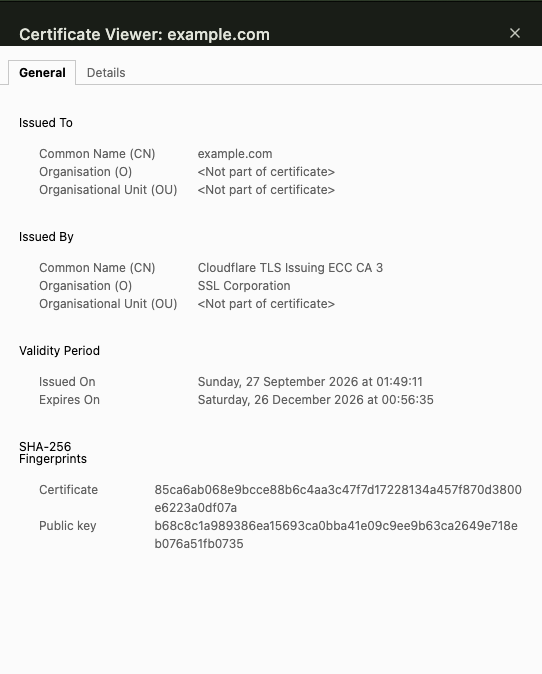
When a user sees that the domain and organization name in the certificate match, they understand the website belongs to the specified company, not to scammers. This builds trust and creates a sense of security when entering payment information.
Support for E-commerce and Banking Integrations
Unlike free SSL certificates, paid ones integrate much more easily with payment gateways and banking systems. For example, some payment or financial institutions recommend OV/EV certificates in their security requirements to verify the identity of the company accepting payments.
In these cases, a paid SSL is required not because a free one is technically inferior, but because a DV certificate doesn’t verify the legal entity. This applies more to B2B integrations, corporate APIs, or when a bank wants official confirmation that a website belongs to a specific company.
Before connecting a payment system, check with technical support to see which certificate it accepts. Some payment gateways may only work on websites with EV certificates.
Valid for one year
A paid certificate is typically issued for one year. This means you don’t have to constantly worry about renewing it or fear that one day your website will stop working because the certificate has expired.
You can purchase an SSL certificate for several years at once and forget about it until you receive an email reminder. HostPro customers receive emails two weeks before their certificates expire.
Drawbacks
For some people, paid SSL certificates aren’t always the best solution. Website owners may choose not to use them for several reasons:
- There’s a cost involved. SSL certificates start at $6.50 per year. Although this purchase is an investment in security and stability, some may view it as unnecessary or too expensive.
- Company verification is required. If you choose OV or EV verification, you’ll need to provide documents confirming corporate status. This makes obtaining an SSL certificate more complicated and time-consuming, unlike free certificates, which are issued in literally a minute.
In Conclusion
Our analysis has shown that e-commerce can’t function without a paid SSL certificate. Handling users’ personal data requires a higher level of security, which only paid solutions can provide. Furthermore, not all modern payment gateways support websites using free certificates.
At HostPro, we offer Certum SSL certificates, including standard commercial, organization (OV), and Extended Validation (EV) certificates for all types of sites and businesses. And if you’d rather not figure it out on your own, contact our technical support—we’ll help you choose the best solution for your online store.