


What is a website competitor analysis?
Services for finding competitors
Competitor analysis: key things to analyze
They learn from their mistakes and painlessly build their own business on the mistakes of their competitors. In this article, we will talk about why your competitors are not an absolute evil, but rather helpful cogs in the process of creating and promoting a website.
What is a website competitor analysis?
A website competitor analysis is a process of identifying and analysing websites with products similar to yours. You should conduct it to understand your competitors’ marketing mix as well as their strengths and weaknesses in order to find opportunities to develop your business.
How to find competitors?
Before you start analyzing your competitors, you need to identify them. To begin with, we will be interested in the strongest players. However, from our own experience, we can say that newly established companies can grow very quickly. Therefore, you should not ignore them completely.
You can find competitors manually through search engines, Google Ads, Facebook, and Instagram, niche rankings, as well as special services such as SemRush, Serpstat, Similarweb, Ahrefs, or SE Ranking.
Through search
Direct search is one of the simplest ways to find competitors. Select 2-3 popular search queries related to your topic — the first results in the search results will usually be advertisements (either yours or your competitors’).It is also important to formulate the most accurate request to find companies who work at the same part of the industry with you. For example, if you sell organic chocolate, you would better search for something like “To buy organic chocolate in Florida”. After that, organic results will be displayed, where we will be able to see the strongest competitors.
It is essential to remember, even when you search for the most exact queries manually the result will still be general, to make a deeper analysis you should use SEO tools.
Expert tip 1: Use incognito mode so that the results are not tied to your search history.
Expert tip 2: Do not forget about using VPN if you sell for a foreign market.
Through Google Ads
After launching an ad, everyone has the opportunity to see who their competitors are. All the information you need for analysis can be found in the “Auction Statistics” report. It is located in the “Keywords” section.
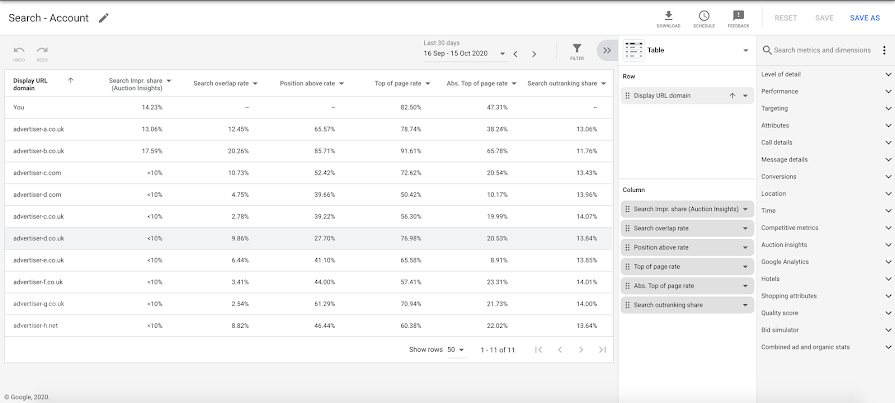
There are also a lot of interesting things to analyse to know more about the competitors.
- Impression rate is a metric that shows how successful your advertising is contrary to the competitor.
- Overlap rate shows how often your ads meet with your competitors’ one in search results.
- Position above rate shows how often your advertising is under your competitors’ ad when you both show in the same search result.
- Top of page rate shows how often your ad shows top 1 is search results, above organic search results.
- Outranking share shows how often your advertising shows higher than a specific competitor.
Expert tip: Separate brand and non-branded keyword to gather more correct information.
Through Facebook and Instagram
If you haven’t run ads on Google yet, you can check out what your competitors are doing on Facebook and Instagram. Let’s look at a few ways to do this.
Through Facebook Ads Library
You can access it through the business pages of competitors you already know or directly via the link.
Follow the link to the Meta Ad Library
Next, enter the query you are interested in into the search bar. That’s it — analyze everyone who advertises on Facebook and Instagram using your keyword. Search results for keywords will not always be clean, as Facebook Ads Library is still working on this.
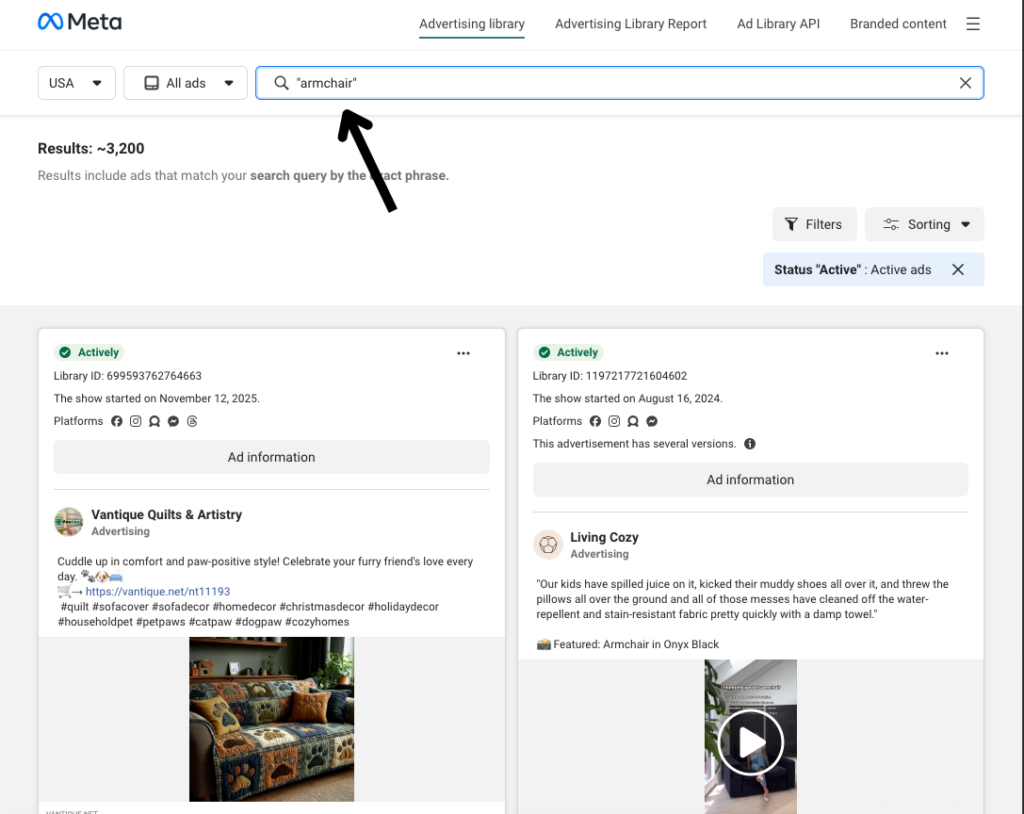
You can also filter the advertising results by ad language, advertiser, platform (Facebook or Instagram), and date. To do this, turn on the filter. It is located just below the search bar. Right here.

Through niche ratings
For medium-sized business owners, this is a pretty good way to find the most serious competitors and for small businesses to find and analyse market leaders and medium-sized companies to understand their path to the top. Usually, new companies rarely appear on such sites, so this way you can identify long-standing and strong companies in the niche you need.
To do this, enter “keyword + rating” or “keyword + reviews” in the search bar.
Looking through these ratings you can identify and analyze market leaders, company positioning and features and services they mention. It is also a great way to find competitors’ pain points in review.
In the current AI era it is essential to know about ratings where your competitors are located because a lot of AI tools usually gather information right from authoritative ranking websites like G2, Trustpoint, etc.
Services for finding competitors
Semrush
This is a paid service —the cheapest subscription costs $169/month, but there is a free 7-day trial, which we will definitely take advantage of.
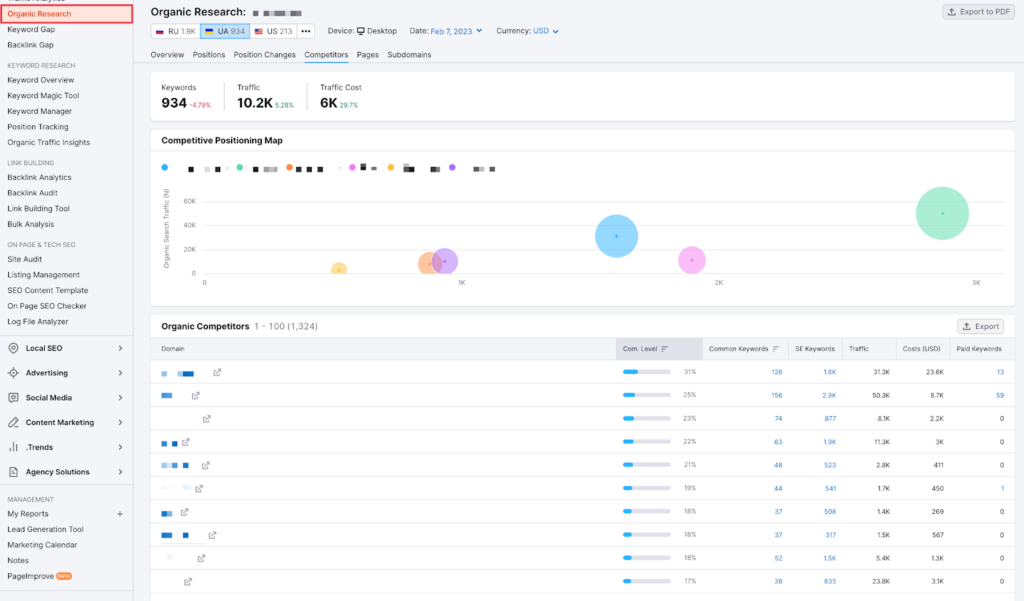
Enter your domain in the search bar and select a region. Once you receive the initial data, go to the “Competitors” tab, where you will find a list of organic competitors and a competitive positioning map. The data can be exported if necessary.
Serpstat
The service is paid. The trial period is 7 days free, then $50/month.
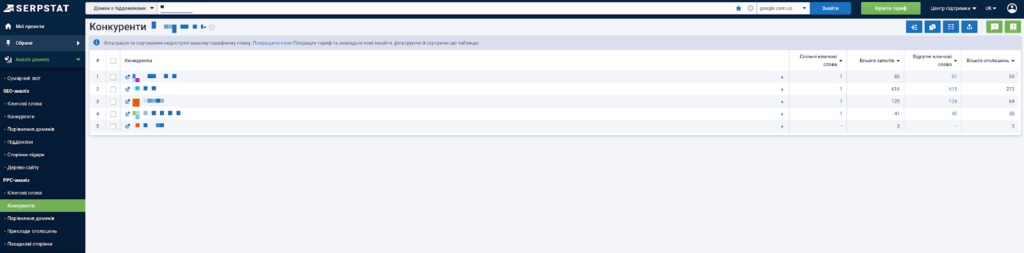
The search procedure is the same as in Semrush – enter your domain ⇒ select a region. Competitor data is displayed in the “PPC Analysis” section ⇒ “Competitors” tab. The report is also ready for export.
Similarweb
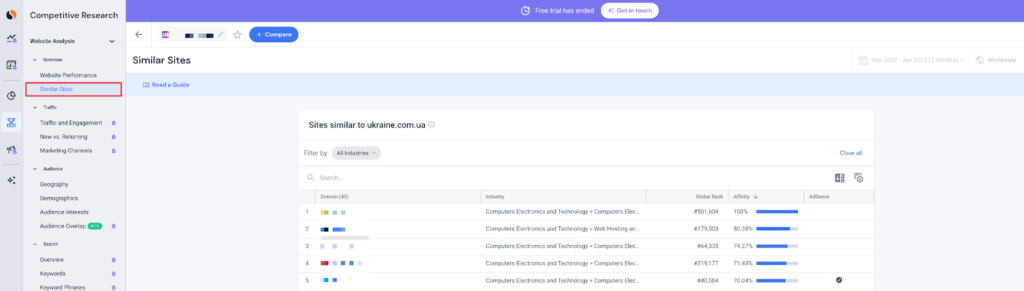
This is a paid service – from $125/month. You can use the trial version for 7 days.
The free plan only allows you to view 5 competitors via the “Similar Sites” tab, and, by the way, the data from it may not be entirely accurate. The “Organic Competitors” and “Paid Competitors” reports are only available when you pay for a subscription.
Ahrefs
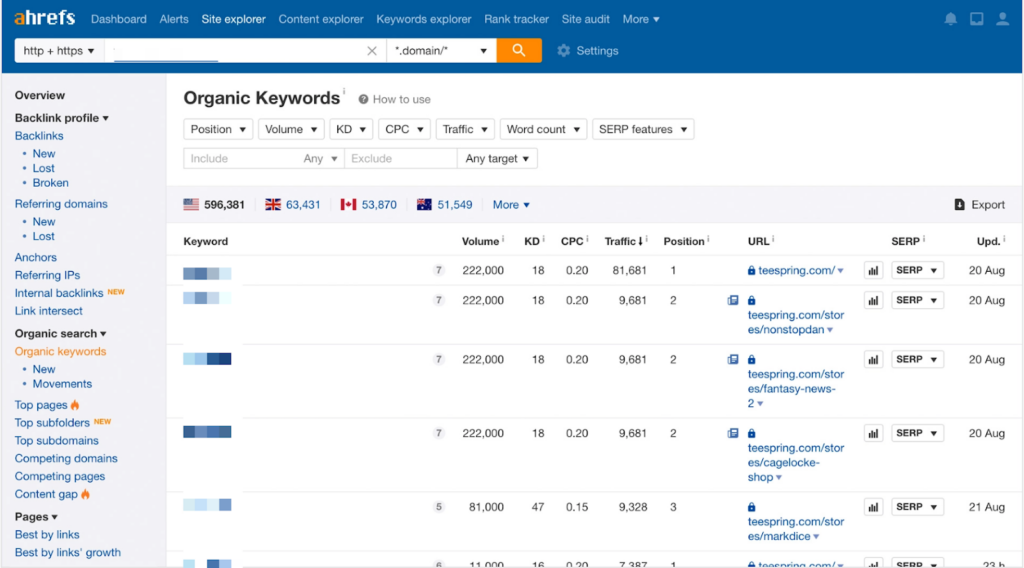
This is a paid service. There is a free version.
To view the list of competitors for free from the “Site Explorer” tab, you need to confirm ownership of the domain or purchase a paid plan. Plans start at $129.
SE Ranking
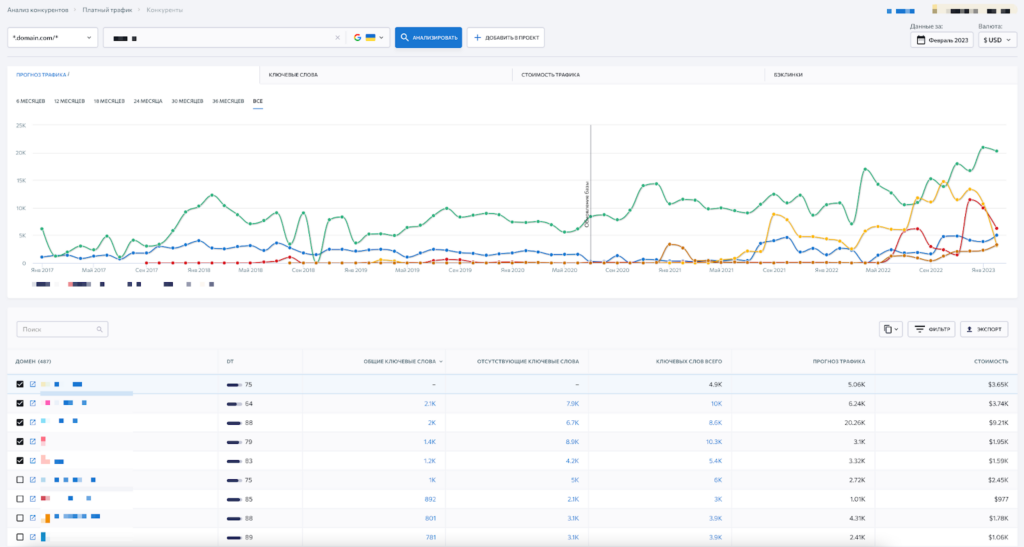
The service is paid – from $52.00/month. They offer a free 7-day trial.
After entering your domain and selecting a region on the main page, go to the reports “Competitors in organic search” and “Competitors in paid search.”
Competitor analysis: key things to analyze
To begin with, it is better not to spread yourself too thin across all competitors, but to select the 10 strongest ones and create a summary table for them. In it, you can record the basic data and then analyze it.
Traffic
We are interested in the following indicators:
- traffic volume (Total Visits);
- where it comes from (Top Marketing Channels);
- session duration (Avg Visit Duration);
- how many pages are viewed per session (Pages per Visit);
- bounce rate (Bounce Rate).
We can get this data from reports from services we are already familiar with, such as Similarweb. Comparing all this information can tell us which channels to pay more attention to and help us identify the growth dynamics of a competitor’s brand.
Referral traffic can also be an informative indicator—from it, we can identify the resources that have brought many customers to competitors. And so, you can also use these same traffic donors for your own purposes.
And the indicators “session duration,” “number of pages viewed per session,” and “bounce rate” should ultimately lead us to a competitor’s website. There, we need to look at the UI/UX, what sections there are, how convenient the ordering process is, and look for useful features that our resource lacks.
Conversely, it is always much easier to find annoying things on someone else’s website — it could be slow loading, pop-up windows, or multimedia that launches automatically. In short, whatever annoys you on a competitor’s website should not be on your own.
Website
Exploring competitors’ websites structure can be much easier when you analyse it using a few basic criteria.
- Technical performance. You can use PageSpeed Insights to analyze main technical metrics;
- Mobile version optimization;
- Pages hierarchy. It is about how main blocks are structured: heading banner, price blocks, checkout, FAQs, etc.;
- Number of CTA buttons and their location;
- On-site content resources. Look if they have FAQs, knowledge base, blog and what they write about;
- Positioning. Analyze their tone of voice, value proposition, target audience, key differentiating;
- Geo and localization. Look if they have optimized pages or a few websites with different domains if they work on a few markets.
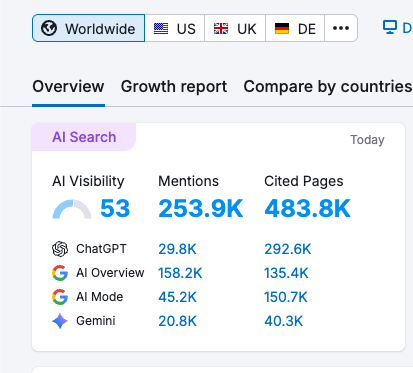
- AI visibility. Use a SEO tool like Semrush to analyze and compare your AI visibility with competitors.
Keywords
It is better to check them through SEMrush, because Similarweb may provide inaccurate data.
The following information will be useful to us:
- queries;
- positions for queries;
- pages search intent;
- amount of organic and paid keywords;
- pages to which keywords lead.
This data will be useful when creating advertising campaigns in the future. You can immediately add queries that you have not yet advertised for to your list and check how much competition there will be for them.
Number of orders
This information is quite difficult to obtain — it is rarely possible to find it on Google, especially when the company is not public. But there are two tricks you can use to find it out.
- Through order IDs. Often, the order ID is the transaction number. So you can simply place two orders in a row, and if their IDs look like ID 165478 and ID 165480, then we’ve probably hit the nail on the head. Then you can place an order with a week’s difference and subtract the new order number from the old one to find out how many transactions took place during this period.
- Through outgoing traffic to payment systems. Let’s note right away that the number of people who proceeded to payment will be approximate. How to calculate: “inbound traffic volume x share of outbound traffic to payment systems.” This data can be found on Similarweb.
User journey
When you work on your project for a long time, your vision becomes blurred and you simply stop noticing the obvious. And the best way to notice it is by looking at the differences. Go through your competitor’s funnel:
- place an order;
- make a payment;
- receive the product/service and check how your competitor deals with problems;
- check how refunds work.
It is better to place an order not from the main page, but from the most popular landing page. You can find it in Ahrefs (section “Top Pages”).
Retention
Understanding where your competitors’ customers come from and how many of them place orders is only half the battle. It is very important for us to analyze how the company retains its customers. The easiest way to do this is to become one of these customers.
What’s the plan? We enter our email address on all available forms and receive letters and SMS messages from competitors. You can also segment the content — enter one email address in your personal account and another in other forms.
It is also advisable to check the work of managers and support staff. Direct communication can tell you a lot about a company and answer questions about how your competitors sell services and solve problems. So don’t be afraid to knock on their chat or call them — it will answer many questions.
Reviews
We advised you to visit ratings and check reviews about competitors at the beginning of the article for a reason. The fact is that this is the easiest way to identify a competitor’s weaknesses. The latter need to be turned into your own areas of growth, and you need to do it as quickly as possible. Because every good company also knows how to identify gaps and work with them.
Have you seen a negative comment about a competitor? Work with it. The only thing we would not recommend is to sell your product in response to such reviews and offer it as an alternative. This will make it more difficult to gain trust. It is better to engage the dissatisfied customer in an honest conversation about what prompted them to react in this way. Then simply turn your competitor’s disadvantage into your advantage.
In conclusion
We have now discussed how and why to analyze competitor websites yourself. However, it is important to remember that the competitiveness of your website largely depends on the hosting service it uses.
If you are looking for a host or have decided to change your hosting provider for some reason, pay attention to the following parameters.
We will gladly transfer your websites to our servers free of charge and with the utmost care. All you need to do is fill out the application form on our website.